

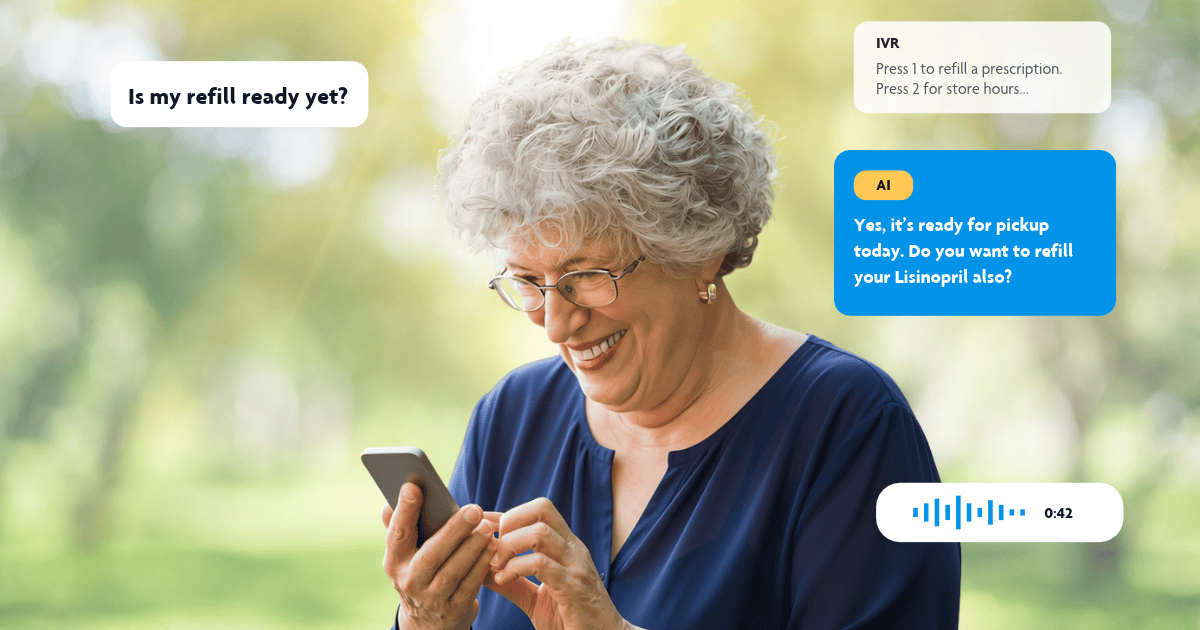
Think back to your last rush. How many times did the phone ring while your team was filling prescriptions, counseling a patient, or helping someone at the counter?
For a small pharmacy team, every interruption adds up. Calls about refill requests, prescription status, and store hours are important, but answering each one can pull staff away from other responsibilities.
Phone automation gives pharmacies a way to manage these routine calls without requiring someone to answer every time. But not all phone automation works the same way.
Types of phone automation systems for pharmacies
A traditional pharmacy IVR system uses automated menus and keypad prompts to guide callers through common requests. A pharmacy AI phone assistant takes a more conversational approach, allowing patients to explain what they need in their own words.
Both address a familiar pharmacy challenge, but they represent different approaches to handling phone calls. Understanding the difference can help you decide what makes the most sense for your pharmacy today and where you may want to go next.
What is a pharmacy IVR system?
Interactive voice response (IVR) is a familiar part of pharmacy operations. For many pharmacies, an IVR system is the backbone of their phone workflow.
According to the 2026 NCPA digest, 66% of pharmacies now use an IVR system (up from 56% in 2024).
An IVR system uses automated greetings, recorded prompts, and keypad selections to direct callers and handle routine requests without requiring a staff member to answer every call.
What a pharmacy IVR can do
Depending on the system and its integrations, a pharmacy IVR can help your team:
- Accept prescription refill requests and send them to your pharmacy management system.
- Notify patients when prescriptions are ready for pickup.
- Route calls to the appropriate person or department.
- Manage after-hours calls.
- Handle a high volume of incoming calls without creating busy signals.
Why IVR remains a trusted standard
IVR is a proven approach to pharmacy phone automation. Its structured menus give callers a predictable way to complete common tasks, and established workflows can help staff manage routine requests throughout the day.
For pharmacies that need reliable call handling and a familiar process for patients, a pharmacy IVR system remains a practical choice.
The experience is structured by design. Callers listen to the available options, select the appropriate prompt, and follow the steps to complete their request. For patients who know what they need, that can be a straightforward way to get it done.
What is a pharmacy AI phone assistant?
A pharmacy AI phone assistant, also known as an Interactive Voice Agent (IVA), brings a more conversational approach to phone automation. Instead of requiring callers to navigate a series of keypad prompts, it uses AI to understand what a patient is asking and respond accordingly.
For example, a patient might call to ask whether a prescription is ready, request a refill, or confirm the pharmacy’s hours. Rather than listening for a menu option, the patient can explain the request in natural language. The keypad is still there when it helps. For details like a prescription number or date of birth, patients can type them in, just as they would with an IVR.
A pharmacy AI phone assistant is designed to make common phone interactions feel more like a conversation while reducing the number of routine calls that require staff attention.
What a pharmacy AI phone assistant can do:
Depending on its capabilities and connection to your pharmacy systems, an AI phone assistant can help your team:
- Accept refill requests through natural conversation.
- Check prescription refill eligibility.
- Provide prescription status updates.
- Answer common questions about pharmacy hours and location.
- Share what a prescription will cost, if your pharmacy management system supports it.
- Transfer callers to a staff member when a request requires human assistance.
How AI voice expands what phone automation can do
Traditional IVR follows a defined menu structure. A conversational AI phone assistant offers another way for patients to communicate what they need without having to identify the right menu option first.
That distinction can be especially valuable for patients who aren’t sure which option to select or who prefer to explain their request by simply speaking like they would with a team member.
AI-powered phone automation also introduces new possibilities for how pharmacies manage routine interactions. As capabilities evolve, the focus is on making phone service more responsive to patients’ needs while helping pharmacy teams manage their workload.
The goal isn’t to remove the human element from pharmacy service. It’s to make routine interactions easier to manage and help staff focus on the conversations that benefit most from their expertise.
Pharmacy IVR vs. AI phone assistants: Key differences
Both technologies can automate routine phone interactions, but they approach the caller experience differently.
| Pharmacy IVR | AI Phone Assistant | |
|---|---|---|
| How patients interact | Follow recorded prompts and select keypad options | Describe what they need in natural conversation, with keypad entry for details like Rx numbers and dates of birth |
| How requests are handled | Follow predefined menus and workflows | Use AI to interpret requests and respond within supported capabilities |
| Routine pharmacy calls | Can handle refill requests, pickup notifications, and call routing via keypad entry | Can handle refill requests, prescription status checks, cost questions, common questions, and call routing through conversation |
| Caller experience | Structured and predictable | More conversational and flexible |
| Best-known strength | Established, dependable call management | A more natural way to automate routine interactions |
Actual capabilities vary by product, pharmacy management system, and configuration. Before choosing a solution, confirm which functions are supported and how each handles requests that require staff assistance.
Which phone automation approach is right for your pharmacy?
There’s no single answer for every pharmacy. The right fit depends on your current phone workflows, your patients’ needs, and the types of calls your team handles most often. Your needs may also shift over time, so it helps to understand what each approach does well.
An IVR may be the right fit if…
- You want a proven, established way to manage high call volumes and routine requests.
- Your patients are comfortable with a familiar, straightforward experience using keypad prompts.
- You need dependable features such as refill requests, pickup notifications, and after-hours routing
- You just want to continue answering your own calls but want a fallback when busy or closed.
An AI phone assistant may be worth exploring if…
- You want patients to communicate their needs without navigating keypad menus.
- Your team spends significant time answering repetitive questions.
- You want to explore newer approaches to conversational phone automation.
- You’re looking for ways to make routine phone interactions more convenient for patients and staff.
Neither approach eliminates the need for personal service. Medication counseling, clinical questions, and situations requiring professional judgment still call for your pharmacy team. Effective phone automation helps direct those interactions to the people best equipped to handle them.
Which phone automation approach is right for your pharmacy?
Whether you’re evaluating a pharmacy IVR system or a pharmacy AI phone assistant, look beyond the technology itself. The right solution should fit the way your pharmacy operates.
Does it connect with your pharmacy management system?
Confirm that the solution supports your specific pharmacy management system and the workflows you need. Ask which functions are available through the integration, rather than assuming every advertised feature will be supported.
How does it handle calls it can’t resolve?
Automation should make it easy for callers to reach a staff member when they need one. Ask how call transfers work, what information carries over, and what happens when the system cannot fulfill a request.
What experience will your patients have?
Consider your patient population, language needs, and comfort with automated phone systems. A live demonstration can help you evaluate how easily patients can complete common tasks.
What safeguards are in place?
Ask about data protection and what security safeguards are in place. Understand the vendor’s responsibilities and your pharmacy’s obligations under HIPAA. Explore an AI voice solution purpose-built for pharmacies to ensure patient data is protected.
What is the total cost?
Compare monthly pricing, setup fees, optional features, integration fees, and any other charges. Consider the time your team spends handling routine calls today and how a new solution could change those workflows.
Understand what routine calls cost your team
Phone automation is about more than answering calls. It’s also about understanding how much staff time goes toward repetitive tasks throughout the day.
Think about how many calls your pharmacy receives, what percentage involve routine requests, and how long your team spends handling them. Even small amounts of time can add up across a week.
Use the calculator below to estimate how much staff time routine phone automation could potentially free up at your pharmacy.
Estimates are based on the inputs you provide. Actual results will vary depending on your call volume, workflows, and the capabilities of your chosen solution.
Explore phone automation built for pharmacies

Pharmacy IVR has earned its place as a trusted standard for managing routine calls. AI phone assistants build on the broader evolution of phone automation, offering a conversational way to handle supported requests.
If you’re exploring your options, Lumistry offers solutions for both approaches:
Explore Voice IVR to learn about our feature-rich hosted IVR & VoIP system, purpose-built for pharmacies and trusted by over 4,500 stores nationwide.
Explore Voice AI Assistant to learn about our AI-powered assistant that delivers quick, human-like support using your existing pharmacy phone workflows.
Want to learn more about our phone automation options?
Take a closer look at Lumistry’s approach to pharmacy phone automation, from our trusted IVR to next-generation AI voice solutions.