


Health literacy in pharmacy is a patient’s ability to find, understand, and use medication information, from the prescription label to the education sheet in the bag. Every prescription comes with information, but that doesn’t mean patients understand it, remember it, or know what to do with it. How a pharmacy delivers that patient education matters as much as the information itself.
The numbers also point to a shift in how patients want to receive health information. Paper materials may not be getting the attention pharmacies hope for, while digital channels are becoming a more common part of how patients find and engage with health information. For pharmacies, this creates an opportunity to move medication education beyond the printed page and meet patients in the digital spaces they already use.
What is health literacy in pharmacy?
Health literacy in pharmacy is the practical side of a broader idea. The Centers for Disease Control and Prevention defines personal health literacy as “the degree to which individuals have the ability to find, understand, and use information and services to inform health-related decisions and actions for themselves and others.” ⁴
At the pharmacy counter, that comes down to whether a patient knows:
- What a medication is for
- How and when to take it
- What side effects to watch for
- How to use a medication or device correctly
- What to do if a dose is missed
- When to contact a pharmacist or other healthcare professional
These sound like simple questions, yet familiar instructions trip patients up. In a study of 10 common prescription label instructions, comprehension ranged from 89% for the clearest instruction down to 53% for the least clear.⁵ Even the easiest instruction was misread by about one patient in 10.
Those errors usually trace back to the wording, not to inattention. Improving health literacy starts with accepting that handing a patient information and making sure they can use it are two different jobs.
When more medication education isn’t necessarily better
Pharmacies already provide patients with a significant amount of medication information.
There are prescription labels, Medication Guides, education sheets, verbal counseling, and additional instructions for certain medications or services. All of these resources have a role to play.
The challenge is getting patients to engage with them.
Printed Medication Education contains everything a patient needs to know, but the long, text-heavy documents can be difficult to navigate, particularly when someone is looking for one specific answer.
Research examining prescription drug labels has found that factors such as medical terminology, abbreviations and complicated instructions can make information harder to comprehend. Clear language and specific directions, on the other hand, can improve understanding.⁶
Having the right information available is only part of the equation. Patients also need to be able to find what they need, understand what it means and know what to do with it.
Patients already have a preferred way to find information
Today, patients are turning to AI searches or Google when they have questions about their health and medications. They search for answers, watch videos, and look for quick explanations that can help them understand what to do next. The challenge is making sure the information they find is accurate, easy to understand, and comes from a source they can trust.
Pharmacies can help fill that gap by providing digital medication education patients can access when they need it. A trusted pharmacy resource gives patients an alternative to sorting through search results or relying on information from sources they may not know or trust.
Digital education can also make certain instructions clearer. Research supports the value of visual approaches, including video, in improving health literacy and comprehension of health information.⁷ This can be especially useful when medication instructions involve a process rather than a simple explanation. A patient learning to use an inhaler, administer an injectable medication, or operate another device may benefit from seeing the steps demonstrated.
And unlike a conversation that happens once at the pharmacy counter, a digital resource can be revisited whenever questions come up, giving patients a reliable source to return to.
QR codes make education easier to access
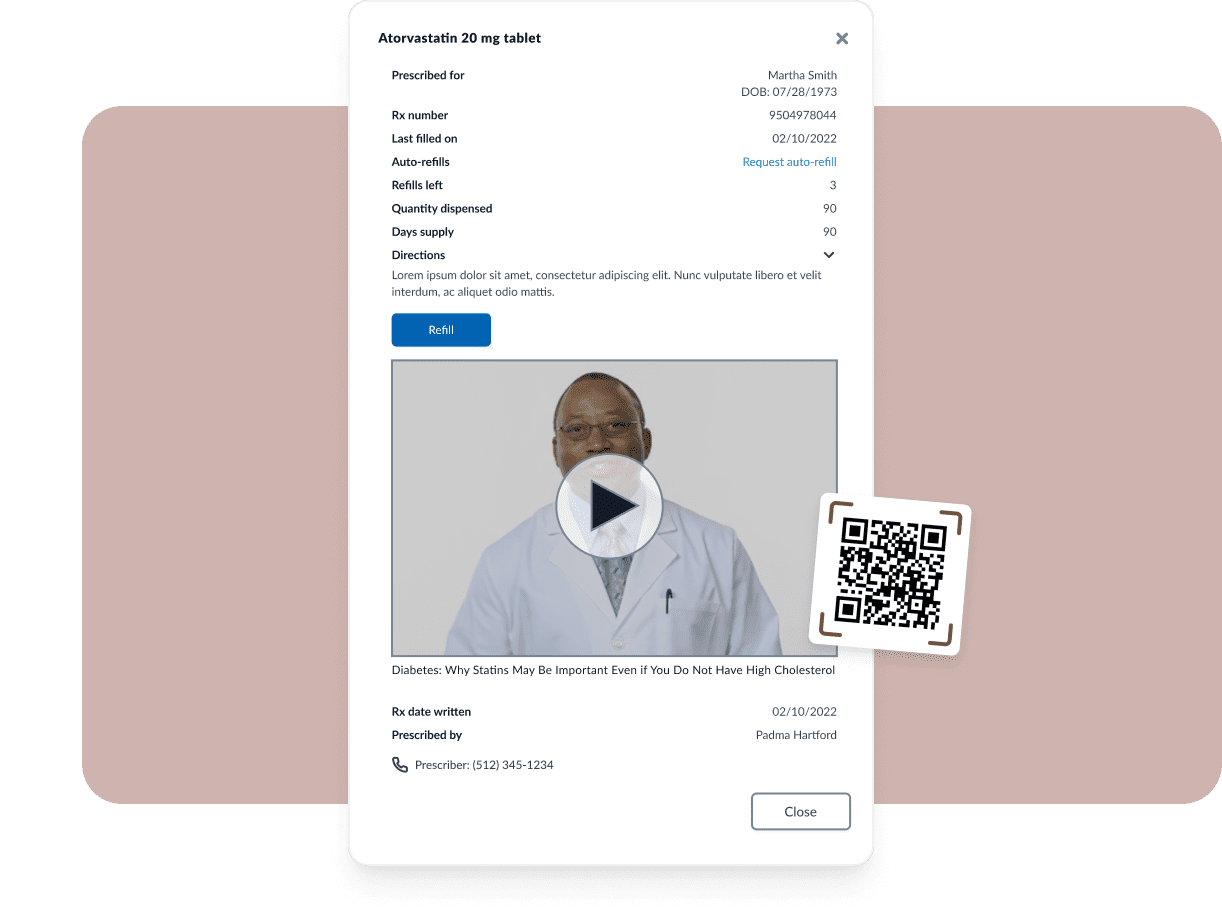
A QR code on a prescription label or medication packaging can give patients a direct path to digital education on their phone, right when they need it. Instead of relying on a printed handout that can get left behind, misplaced or forgotten, the information stays connected to the medication.
That matters because patients don’t always have questions when they pick up a prescription. They may think of one later that evening, when they’re taking their first dose or when they’re trying to remember something their pharmacist explained. With a QR code, they can access the information again when the question comes up, rather than trying to find a piece of paper they may no longer have.
Research examining QR codes for electronic patient information found that most patients surveyed were willing to use them to access medication information, with the majority finding the process easy to use.⁸
For pharmacies, QR codes offer a simple way to make digital education part of the existing prescription experience. Patients get information they can return to when they need it, while the pharmacy makes education more accessible beyond the moment of pickup.
How pharmacies can make medication education more useful
Improving health literacy doesn’t necessarily require a complete overhaul of how a pharmacy communicates with patients.
Start with a few simple questions.
Is the information easy to understand?
Look for opportunities to use plain language and specific instructions.
Instead of assuming patients understand medical terminology or pharmacy shorthand, consider whether the information could be explained more simply.
The goal isn’t to provide less information. It’s to make the information patients receive more useful.
Can patients access it when they need it?
Medication questions don’t always happen at the pharmacy counter.
A patient may get home and realize they aren’t sure how to use a medication. A family member may have a question later that evening. A caregiver may need to review the instructions the next day.
Giving patients a way to return to the information can make education more useful beyond the initial pharmacy visit.
Are you giving patients more than one way to learn?
Not everyone processes information the same way.
Some patients prefer reading. Others may understand a concept more easily when they can watch it being demonstrated.
Offering written and digital resources gives patients more flexibility while keeping the pharmacist’s personal guidance at the center of the experience.
Can you provide additional education without adding more work (or additional costs)?
This matters in a busy pharmacy.
Any approach to health literacy should fit into the pharmacy’s existing workflow rather than create another manual task for staff.
Digital education can help pharmacies extend the information they already provide without requiring the team to print, organize or individually explain every resource.
Give patients another way to learn
Lumistry’s Paperless Education gives pharmacies access to a digital library of over 1,500 medication videos created by pharmacists, covering medications, administration techniques, and health conditions.
Content is available in multiple languages and can be delivered through QR codes and the Patient Portal.
Instead of relying on a patient to hold onto a piece of paper and remember to read it later, pharmacies can give patients an education resource they can access on the device they already use every day.
When pharmacies meet patients where they already look for information, medication education can become a more useful part of the care experience, not just another handout at the counter.
Put health literacy into practice.
Explore how digital education can help patients engage with medication information in a way that works for them!
Citations
- Nathan JP, Zerilli T, Cicero LA, Rosenberg JM. Patients’ use and perception of medication information leaflets. Annals of Pharmacotherapy. 2007. Source.
- Davis TC, Wolf MS, Bass PF, et al. Literacy and misunderstanding prescription drug labels. Annals of Internal Medicine. 2006. Source.
- The Drum/YouGov. US consumers can’t quit QR codes. 2021. Source.
- Centers for Disease Control and Prevention. What is health literacy? Source.
- Davis TC, Federman AD, Bass PF, et al. Improving patient understanding of prescription drug label instructions. Journal of General Internal Medicine. 2009. Source.
- Maghroudi E, van Hooijdonk CMJ, van de Bruinhorst H, van Dijk L, Rademakers J, Borgsteede SD. The impact of textual elements on the comprehensibility of drug label instructions (DLIs): a systematic review. PLoS ONE. 2021;16(5):e0250238. Source.
- Galmarini E, Marciano L, Schulz PJ. The effectiveness of visual-based interventions on health literacy in health care: a systematic review and meta-analysis. BMC Health Services Research. 2024;24:718. Source.
- Singh G, Brand SJ, Steenkamp V. Transitioning to quick response codes for patient information leaflet delivery. Exploratory Research in Clinical and Social Pharmacy. 2025;17:100563. Source.